
PUBLISHED
Why Duck Makes a Great Treat for Dogs
4 views
A Closer Look at the Nutritional Benefits of Duck
Duck is a flavorful, protein-rich treat option that provides essential amino acids and naturally occurring nutrients. Learn why duck can be a smart addition to your dog’s treat routine, how it may serve as an alternative protein for some dogs, and how to feed treats responsibly.
Why Duck Makes a Great Treat for Dogs
When choosing treats for your dog, the ingredient list matters.
Treats may be a small part of a dog’s daily diet, but they are still an opportunity to provide something flavorful, rewarding, and nutritionally meaningful. Among the many animal proteins available today, duck has become an increasingly popular choice for pet parents looking for a simple and naturally protein-rich treat.
But what actually makes duck a good option for dogs?
Let’s take a closer look at the nutritional value of duck, how dogs use dietary protein, and why duck can be a useful addition to a thoughtful treat routine.
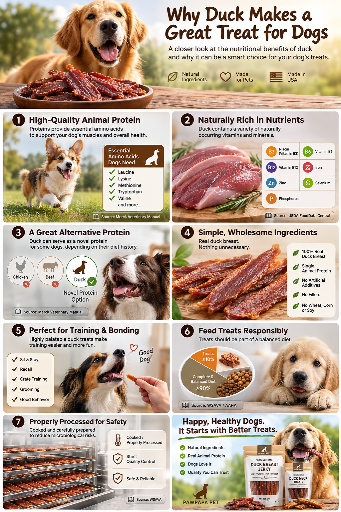
1. Duck Is a Source of High-Quality Animal Protein
Protein is an essential part of canine nutrition.
Dogs use dietary protein as a source of amino acids, which are needed to build and continually renew tissues throughout the body. According to the Merck Veterinary Manual, dogs require ten essential amino acids in their diet, including leucine, lysine, methionine, tryptophan, and valine.
Animal-based proteins such as duck naturally provide protein and amino acids that contribute to a dog’s overall dietary protein intake.
For active dogs, growing dogs, and adult dogs alike, adequate protein is an important part of maintaining normal body tissues and muscle.
That does not mean a treat should replace a complete diet. Instead, a meat-based treat can be a simple way to provide a highly appealing reward while contributing additional animal protein.
Source: Merck Veterinary Manual, “Nutritional Requirements of Small Animals.”
2. Duck Naturally Contains Important Nutrients
Duck is not only a source of protein.
USDA nutrient data for cooked duck meat shows that it naturally contains a range of micronutrients, including:
- Iron- Zinc- Selenium- Phosphorus- Niacin (Vitamin B3)- Riboflavin (Vitamin B2)- Vitamin B6- Vitamin B12
The exact nutrient content of a finished pet treat depends on the cut of meat, preparation method, moisture level, and processing conditions. Still, using real duck meat as the primary ingredient gives pet owners a recognizable animal-based ingredient rather than relying solely on flavorings.
For example, USDA data lists cooked domesticated duck meat as a protein-containing food and identifies niacin among its naturally occurring nutrients.
For pet parents who prefer simpler ingredient lists, this is one of the attractions of meat-focused treats.
3. Duck Can Offer Variety in a Dog’s Protein Rotation
Many dogs eat chicken or beef every day through their regular food.
Duck offers another animal protein option and can introduce variety into a dog’s treat routine.
Variety itself is not medically necessary for every dog, but some pet owners prefer rotating treat proteins rather than giving the same flavor every day.
Duck also has a distinctive aroma and taste that many dogs find highly appealing, which can make duck treats particularly useful as:
- Training rewards- High-value rewards- Occasional snacks- Rewards during walks- Positive reinforcement during grooming- Rewards for recall or obedience practice
Because treats are often used to reinforce behavior, palatability matters. A treat only works as a reward if the dog actually wants it.
4. Duck May Be Considered a Novel Protein for Some Dogs
One of the most interesting characteristics of duck is its use as a so-called novel protein.
In veterinary nutrition, a novel protein is a protein source that a particular animal has not previously eaten.
The Merck Veterinary Manual notes that veterinary elimination diets may use novel protein sources such as duck, rabbit, venison, fish, or kangaroo depending on an animal’s previous dietary history.
This does not mean that duck is automatically hypoallergenic.
A dog can potentially develop a reaction to any dietary protein, including duck. Whether duck is truly “novel” depends entirely on what that particular dog has eaten before.
However, for a dog that has primarily eaten common proteins such as chicken or beef and has never consumed duck, a veterinarian may sometimes consider duck when evaluating novel-protein dietary options.
Food allergies should always be diagnosed through a veterinarian-supervised elimination and challenge trial rather than simply switching treats.
Source: Merck Veterinary Manual, “Cutaneous Food Allergy in Animals” and “Nutrition in Disease Management in Small Animals.”
5. Duck Can Be a Simple, Single-Animal-Protein Treat
Ingredient simplicity is increasingly important to many pet owners.
A straightforward duck treat can make it easier to understand exactly what you are giving your dog.
Products made primarily or exclusively from duck avoid the long ingredient lists found in some highly processed treats.
This can be especially useful for pet parents who want to keep track of which animal proteins their pets consume.
However, owners of dogs currently participating in a veterinary elimination diet should be particularly careful. Even a small treat containing an unapproved protein can interfere with an elimination trial.
The Merck Veterinary Manual specifically notes that treats and other food-based items must be controlled during food-allergy testing.
If your dog is currently on a prescription or elimination diet, always speak with your veterinarian before introducing a new treat.
6. Meat-Based Treats Can Be Excellent Training Rewards
Food rewards are widely used in positive-reinforcement training.
Duck treats can work especially well when they can be broken or cut into smaller pieces.
For training, the goal is usually not to give a large snack every time your dog performs a behavior. Instead, small portions allow frequent reinforcement while keeping total calorie intake under control.
A flavorful meat treat can therefore be useful for teaching behaviors such as:
- Sit- Stay- Come- Leave it- Heel- Crate training- Calm behavior around visitors
Small pieces also make it easier to reward frequently without giving your dog an excessive amount of food.
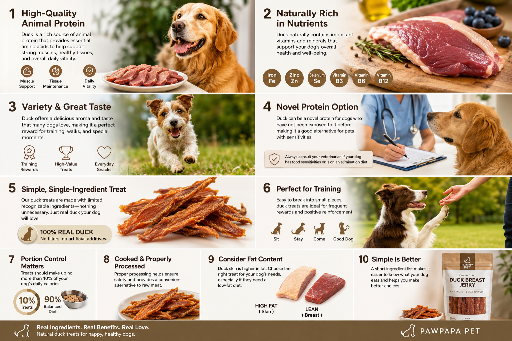
7. Duck Treats Can Fit Into a Healthy Diet — When Portions Are Controlled
One of the most important things to remember about any dog treat is that more is not necessarily better.
The World Small Animal Veterinary Association (WSAVA) recommends that treats account for no more than approximately 10% of a dog’s daily calorie intake.
The remaining 90% or more should generally come from a nutritionally complete and balanced diet appropriate for the dog’s life stage.
The American Animal Hospital Association (AAHA) provides similar guidance, noting that excessive calories from treats can contribute to weight gain and nutritional imbalance.
This means even a high-quality meat treat should still be fed responsibly.
For training sessions, breaking larger duck pieces into smaller portions is often an easy way to reduce unnecessary calories while still giving your dog the reward they enjoy.
Sources: World Small Animal Veterinary Association and American Animal Hospital Association.
8. Cooked and Properly Processed Animal Treats Avoid Some Risks Associated With Raw Meat
Preparation also matters.
WSAVA cautions that unprocessed raw animal-based treats may carry a risk of pathogen transmission.
Likewise, the Merck Veterinary Manual notes that several veterinary and public-health organizations discourage feeding raw or undercooked animal-source proteins because of microbiological risks.
For this reason, properly processed meat treats can offer pet parents a convenient alternative to handling raw meat as a reward.
The specific safety of any product still depends on sourcing, manufacturing practices, storage, packaging, and handling.
Always follow the storage instructions printed on the package.
9. What About Duck Fat?
Not all duck treats have the same fat content.
Duck skin is naturally much higher in fat than lean duck meat. Therefore, the nutritional profile of a duck-breast treat can be very different from a treat made from skin or fattier portions of the bird.
This is worth considering for dogs that need calorie-controlled diets.
A dog with pancreatitis, obesity, gastrointestinal disease, or another medical condition may require dietary fat restriction or a therapeutic diet.
In those situations, even a natural meat treat may not be appropriate without veterinary guidance.
Pet owners should look at the actual product rather than assuming every “duck treat” has the same nutritional characteristics.
10. Simple Ingredients Make Treat Choices Easier to Understand
Pet nutrition does not need to be complicated.
For many pet owners, one of the advantages of a meat-focused treat is transparency: you can quickly understand what the treat is made from.
A simple ingredient list also makes it easier to combine treats with your dog’s regular diet without introducing numerous additional ingredients.
This is particularly useful when keeping a food diary or monitoring which proteins your dog eats.
Still, remember that “simple ingredient” does not automatically mean “complete and balanced.”
Treats are supplemental foods.
Your dog’s primary food should provide complete nutrition appropriate to its age and life stage.
Choosing Duck Treats Responsibly
When evaluating a duck treat, consider a few simple questions:
- Is real duck one of the primary ingredients?- How many ingredients are included?- Is the product cooked or otherwise properly processed?- Does the package provide feeding guidance?- Can the treat be portioned into smaller pieces?- Does the product fit your dog’s daily calorie allowance?- Does your dog have any known medical or dietary restrictions?
For healthy dogs, duck can be a flavorful and highly rewarding addition to a balanced treat routine.
For dogs with allergies, gastrointestinal disease, pancreatitis, obesity, or other medical conditions, consult your veterinarian before making significant dietary changes.
The Bottom Line
Duck offers several qualities that make it attractive as a dog treat.
It is an animal-based source of protein, naturally contains a variety of nutrients, provides a flavor that many dogs enjoy, and may serve as an alternative protein option for dogs that have primarily eaten more common proteins.
Most importantly, a good treat does not need to be complicated.
Real ingredients, responsible portions, proper processing, and a balanced overall diet matter more than exaggerated health claims.
At Pawpapa Pet, we believe treats should be something both pets and their people can feel good about.
Because sometimes the best reward is also the simplest one.
References
-
Merck Veterinary Manual — Nutritional Requirements of Small Animals
Merck Veterinary Manual explains that dietary protein provides essential amino acids needed for normal growth, maintenance, and tissue renewal in dogs.
-
Merck Veterinary Manual — Cutaneous Food Allergy in Animals
This veterinary reference explains the role of elimination diets and controlled dietary challenges in diagnosing food allergies.
-
Merck Veterinary Manual — Nutrition in Disease Management in Small Animals
Merck identifies duck as one of the protein sources that may be used in a novel-protein diet, depending on an individual animal’s previous dietary exposure.
-
World Small Animal Veterinary Association (WSAVA) — Feeding Treats to Your Dog
WSAVA recommends that treats generally account for no more than about 10% of a dog’s total daily calorie intake.
-
American Animal Hospital Association (AAHA) — Nutrition and Weight Management Guidelines
AAHA recommends that complete and balanced foods provide the large majority of a pet’s daily calories.
-
USDA FoodData Central
USDA FoodData Central provides nutrient composition data for foods including duck.